Imperial Motors is a Brooklyn four-piece band playing hopped-up prog-synth-punk as a thesis for the future. I spoke with bassist and co-lead vocalist Liam O’Toole about musical beginnings, group dynamics, and Russia. Listen to the recently released “Charlie Don’t Surf” EP here.
Interview by Teddy Urban.
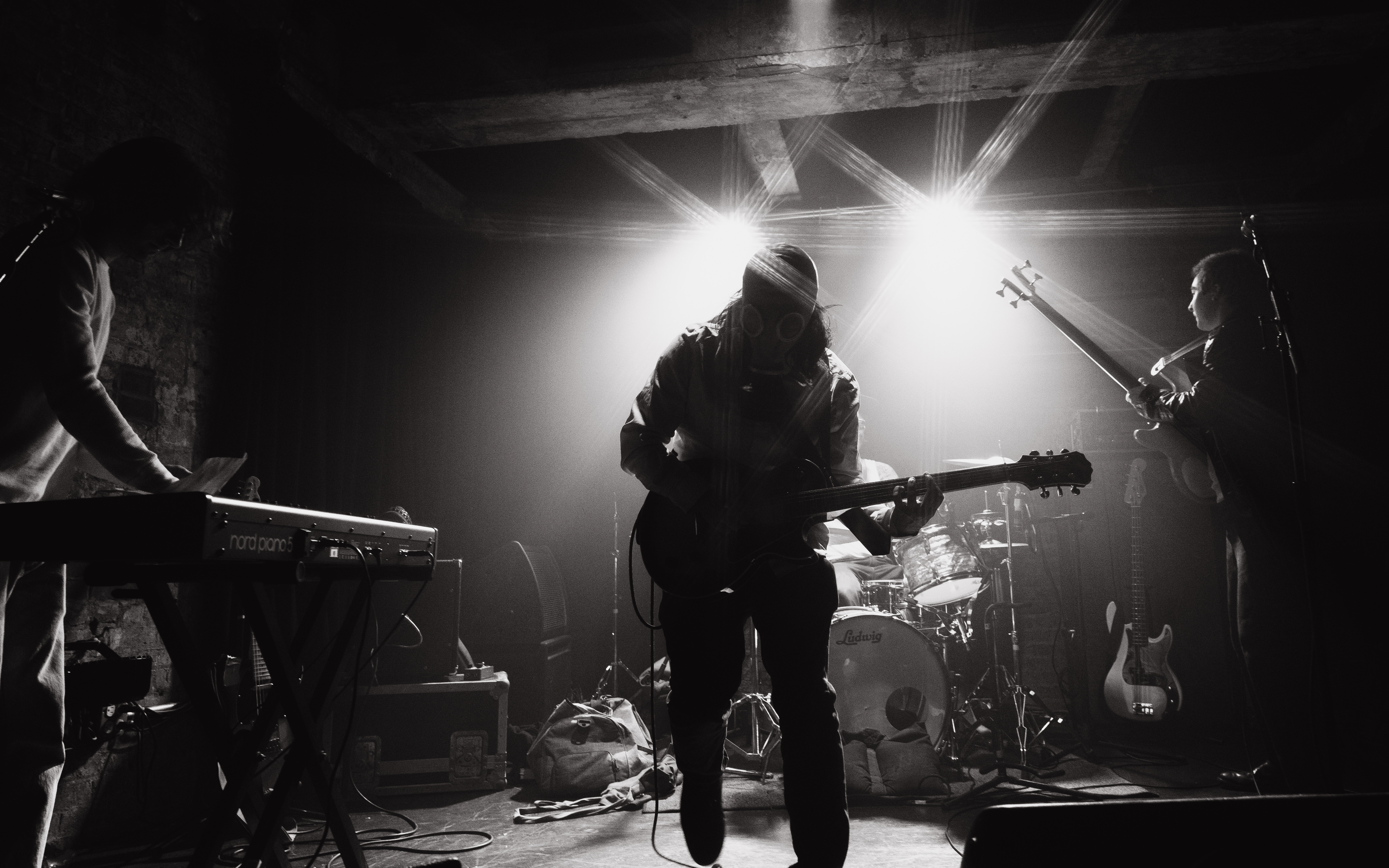
Photos by Sabrina Yanez.
So I know you’ve given me somewhat of a rundown on this in the past, but tell me about your origins with music locally in New Jersey. From what I understand, you were in a band with some guys a bit older than you and sort of ended up on bass guitar out of necessity?
Hah, yeah, we were called Fullcircle. I was far and away the least talented person in it since all of those guys really just did music for a hobby (can you imagine?). I practically begged them to let me join, but they had a bass player already. One day that guy had track practice, so they let me come by, and after a while I was in! Before that, I just played trombone in the school band. I couldn’t read music so I just matched the slide positions of who was next to me or made up my own parts. Trombone wasn’t very ‘cool’ to me. I really wanted to be in a rock band.
Could you highlight any albums, songs, or general musical experiences that were formative for you?
Yes–many, but I’ll limit myself. “Untitled” by Interpol, “The Light” by Spock’s Beard, and “I Ran” by Flock of Seagulls. The latter two were Fullcircle finds; I remember being shown those at my friend’s house after we stole a couple beers from the fridge and went out in the snow. Flock of Seagulls I saw on an MTV 80’s countdown when I was like seven or eight and I thought it was the coolest. I also want to highlight “Fat” by Weird Al Yankovic. Probably the first song I was aware of. Oh, and “Age of Adz” by Sufjan Stevens. That song scared the hell out of me.
Moving ahead to college, I know that’s where you met most, if not all, of Imperial Motors as it is today. Can you give some insight into your experience with music there? Were you playing in bands?
Priority number one when I got to Michigan was to get a band. I was stopping
people on the street who looked like musicians and asking if they wanted to get something going.
Some guy recommended Craigslist, and that’s where Peter Kwitny of
the Kelseys
found me and how I met Josh [Cukier, drums in Imperial Motors]. Ben [Biber, keyboard and guitar] ran in circles
sort of adjacent to ours, but I never met him until New York. Andrew [Garces, guitar] I met
through Fullcircle connections.
I got very lucky with the Kelseys; they were 3 very good musicians and they had a decent
following already. We started out very Local Natives/Hippo Campus, then we got into the 1975;
someone said we sounded like Haircut 100, which is nuts. PK[Peter Kwitny] was a role model–keep
the song under 3:30, get to the point, nothing wrong with a verse-chorus-verse-chorus-bridge-chorus
structure. My proposals in Fullcircle were too pop, and they were too prog for the Kelseys–meet
in the middle and you get Imperial Motors.
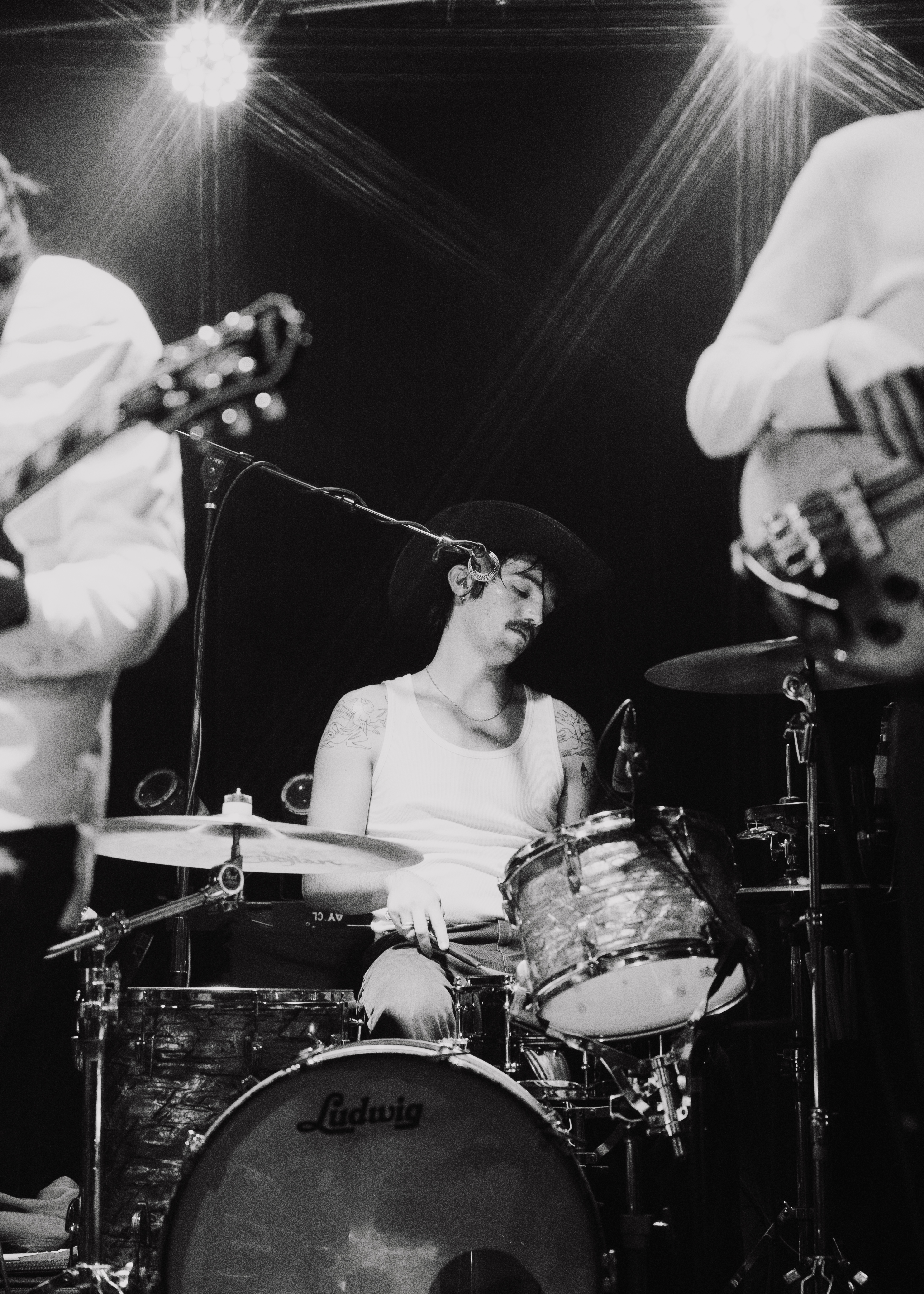
You told me a while ago about having the opportunity to visit Russia and teach there as part of your program at Michigan. How would you say your choice of major and related experiences impacted your outlook on music or art?
The history background definitely the lyrics, come on! I’ll joke that Russia
is basically one giant Pennsylvania–post-industrial, two major urban centers, largely rural,
has some real natural beauty and resources. But that’s to say people are generally the same
and different in similar ways everywhere. Conversely, my historiography capstone was on Soviet
agricultural policy in Uzbekistan, and I was trying to refute or support my professor’s point
that Soviet expansion was part of a continuity of Russian Imperial policy. Like all great works
of undergraduate historiography, my conclusion was yes + no = maybe.
Historiography (the study of how history is studied/made) doesn’t stomach generalizations–the
more thorough you are the better, and you can never 100% conclusively point to something and
say “that is a pipe.” Josh has to remind me that we can always write another song about a
particular topic. Something like “Sonya” doesn’t need to be the end-all-be-all on climate
change, and “Bartender” doesn’t need to be the end-all-be-all on trout cultivation. Every
song needs a ‘thesis’ so to speak, and it’s the audience’s decision whether to believe us.
You’ve told me in the past about an Imp Mo album that was lost to corrupted files and ultimately abandoned–what exactly happened with that? Did anything from that album survive or change into material that exists today with the band?
I wish the files were corrupted, that’d be a less embarrassing reason. I had
a glass of water next to my laptop on the floor and at some point in the night I knocked it
over and fried the thing. But I had demos, and I’m pretty sure we had started some iteration
of Imperial Motors by that point so people knew a couple songs.
The concept was that all the world’s nuclear warheads go off, each song would be a vignette
set in that last second before the apocalypse. As of today, only one song from that era
survived–it’s called “Geek Squad,” and if we’re going for a less punk set we’ll play it.
Frankly, we wrote better songs, and eventually the nuclear apocalypse fell to the wayside
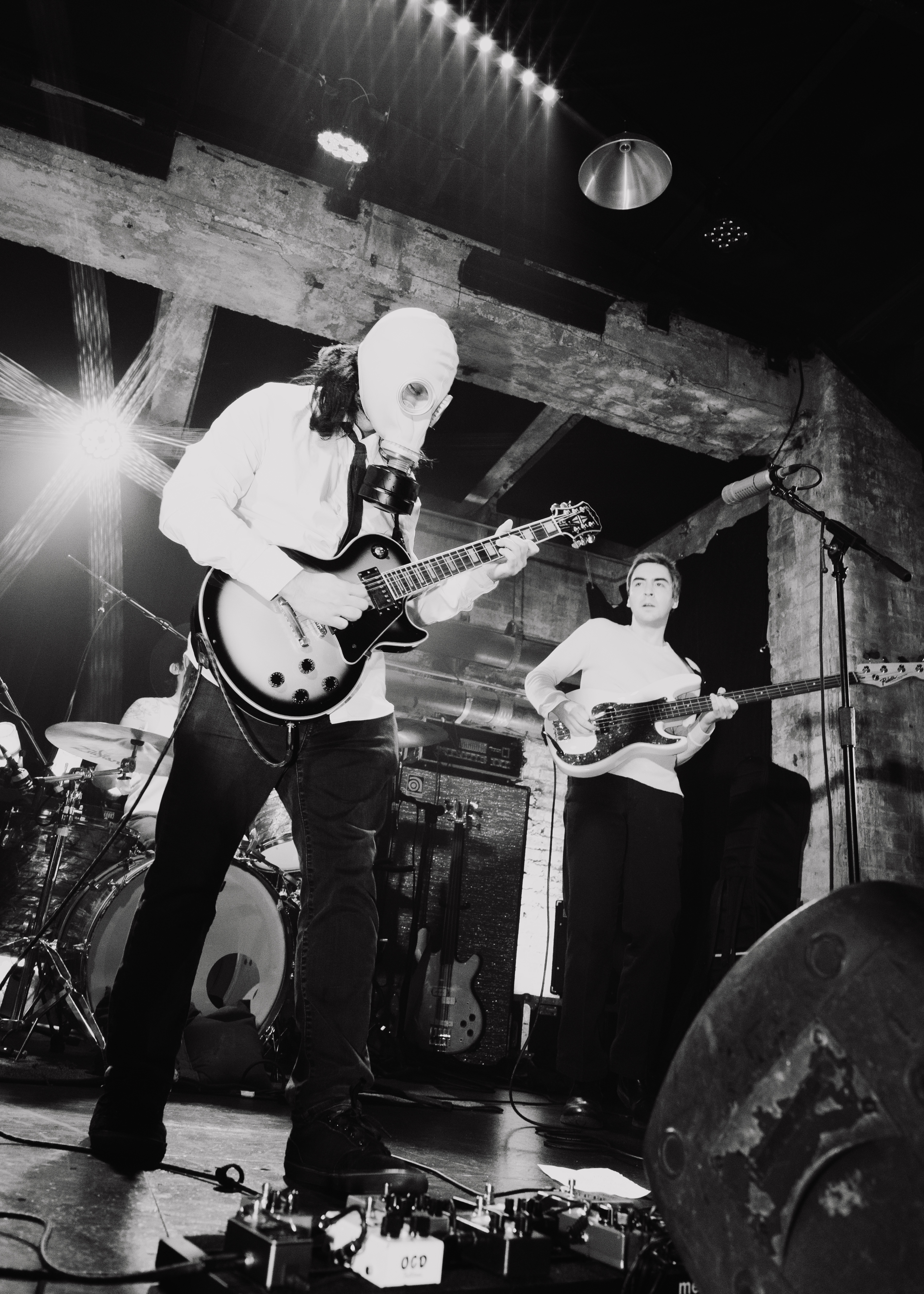
so we wouldn’t have to limit ourselves. One artifact from that period that remains is Andrew’s
mask; we all used to wear them! They’re Soviet army surplus, allegedly.
At what point did the transition happen from solo project to band? As a follow-up, would you define it as a “band” today, and how are duties shared as it pertains to songwriting and production?
We had a couple rehearsals as ‘Liam’s thing’ in preparation for a show that
was eventually cancelled, it lasted like a week. I’d say as soon as Josh joined it became more
of a band. We had worked together in the Kelseys and now that he too was a free agent, he was
also hungry to be creative.
I was anxious about making other people play my music, telling them what to do and all that.
Particularly when those early songs were over-arranged to hell and I didn’t even know which
of the lead guitar parts was the actual lead guitar part. And I wanted it to be a band. I
don’t like the aesthetics of a solo artist.
Naturally the other 3 guys wrote better versions of my proposed parts, and then outright
just better parts. That evolved into composing together and, ergo, “we’re a band.” Andrew
refers to his parts as “butter on the steak” and I think that’s a great analogy. We played
a song called “Step by Step” at Trans Pecos, the one where I don’t play bass. That demo was
fully orchestrated, but we overhauled it–particularly the drums–and the outro is an invention
of the group. “Freeloader” and a song called “Staircase to Nowhere” were total group efforts–we
just did a countoff and that’s what came out.
The “Charlie Don’t Surf” EP makes me so excited for you guys. Seeing the live show develop over the past couple years, I’ve always been amazed by how much it felt packed with sound–there is so much impact in the dynamics, and everyone gets their moments to be at the front. The fact that you all translated that into recordings so well makes me feel that anything is possible going forward. Was it a struggle to make these songs work as recordings?
Thanks, Teddy! We thought not; we selected the songs we did because they were the strongest live at that time and hopefully the easiest to record. The bones of each song were good, the fundamental parts–bass, drums, guitar, keyboard–stayed largely the same. But you know how recording goes.
Were there lots of changes to arrangements or overdubs, or did you stick pretty close to the live setup?
We were doing what you’re told to never do, which is rewriting in the studio.
For instance, the lyrics to “Infinite Money Glitch” and “Sonya” were changing up until we got
final takes. I think Ben’s guitar part on “Bartender” was written in the studio, he used to
just play keyboard on that song. Getting the bells and whistles on “Bartender” took an equivalent
amount of time as tracking the main instrumental. I don’t recall many hills to die on besides
that trombone I played on “Bartender.” Ben and I really wanted the hits to sound like “Oxygen”
by Swans, and a horn paired with guitar seemed the way to go. In the future we’ll want to get
an actual trombonist.
“Freeloader” is exactly how we did it and still do it live, with just some synths in the
outro/intro to build atmosphere. It was the obvious choice for the single, it hit and worked
well since day 1. But I’m happy with the final lyrics, and the overdubs brought us many of my
favorite moments.
Josh hits this insane vocal at the end of “Infinite Money Glitch” which I remember just being
magic when we were tracking it. It completely blew out his voice; out of safety we don’t do
it live. We really didn’t want to overproduce the EP but I think in some areas we may have.
It’s a fine line to walk between sounding lush and amateurish.
Eno
just needed 3 synth tracks right? We’re recording right now and increasingly want to move towards
tracking live. But with the resources we have, we’ll make do.
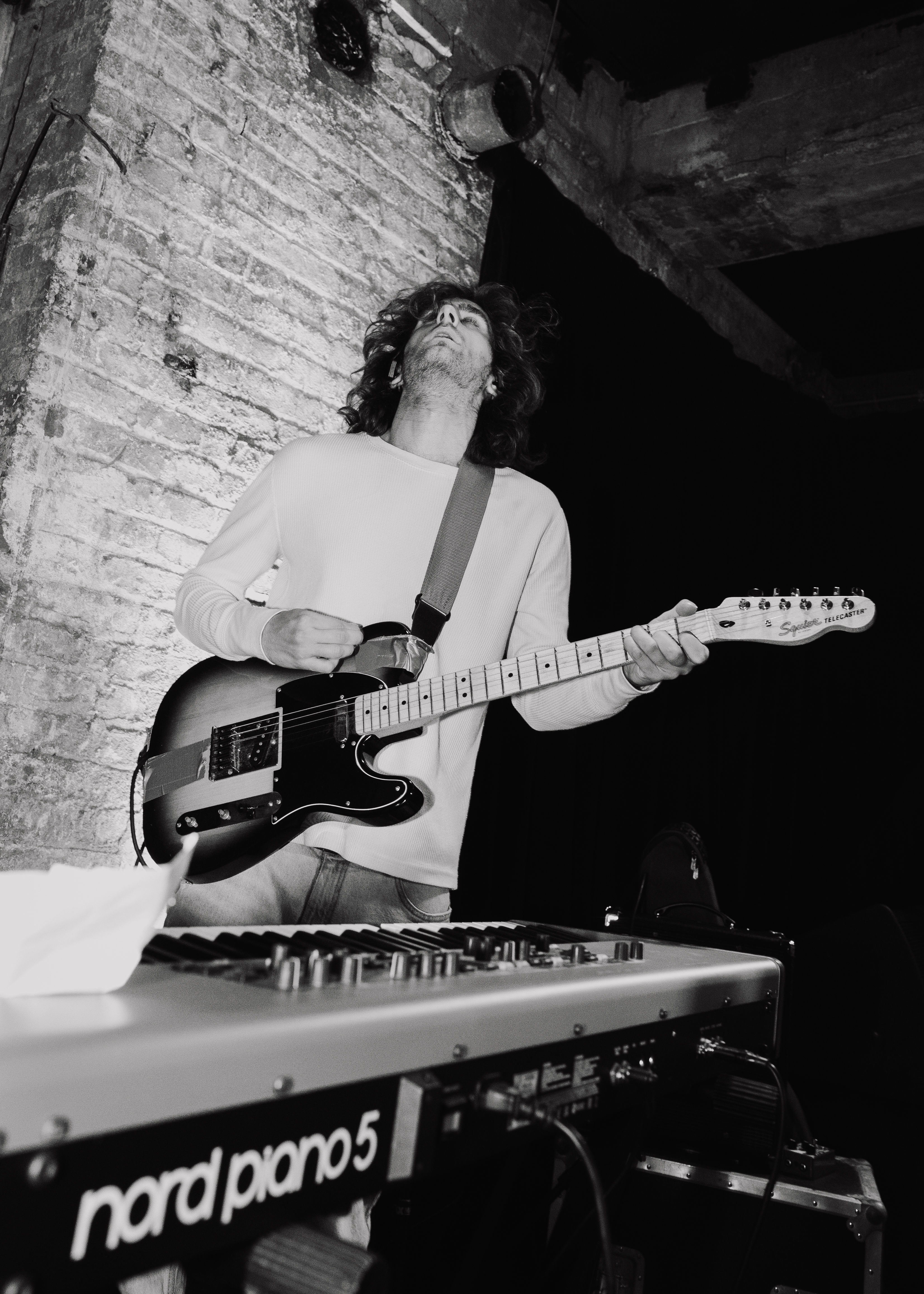
Speaking more about the live show, the four of you feel like real-time cartoon characters on stage. You’ve always seemed to be a natural performer but at this recent show at Trans-Pecos it felt like you coming into a new level of presence on stage, and I feel like I’ve seen that happen for each of you time and again as you progress. Is there a communicated mission between the four of you as far as your performances go, or has this been something that’s developed naturally as you’ve gone on?
Naturally, and over time. Josh and I played a ton of shows in college-- when the music is that prescribed and rigid you have to find other ways to give the performance some flash. I like the cartoon character comparison! Andrew’s stage presence he developed as part of the masked character, and Ben is just a character on stage or off. Our on-stage personas are very much extensions of our real-life personalities, they just get turned up a bit when under pressure I guess.
Do you have any grandiose visions for costumes or stage setups in the future that you haven’t had the opportunity to try yet? And please don’t feel obligated to reveal any secret plans.
Well, first we’re going to [REDACTED] and after that hopefully move onto [REDACTED]. Ben’s been talking to some people and we think we can have the [REDACTED] constructed and delivered by [REDACTED]. Of course, that’s assuming financing from [REDACTED] comes through. In the short term, we’d like to run projections at more shows.
As far as I’m aware, the recording for this EP was quite time-consuming and there may have been plans at the start for a full-length project. Is that still something you’re looking to pursue in the near future, or do you see yourselves using more singles and EPs to explore and develop before you take on a full LP?
It’s a tough situation where in order to make the album for the music we have as good as we want it to be, we have to release music to gain access to the proper resources. The EP tracks were supposed to be part of an LP. Now that they’re released, I’m not sure we’d want to take up space on the eventual album with them, even if they are part of a thematic arc. Of course the prevailing notion is to do the EPs and singles, but maybe the success of something like Getting Killed indicates an appetite for longform music among people. You’re the music journalist, what do you think?
Do you have any personal ambitions beyond Imperial Motors within music, art, writing, et cetera?
Stay busy, get famous.
Lastly, if you could provide a mission statement for Imperial Motors, what would that be?
Eh, how about: “The Soundtracks of Tomorrow, Today”
Imperial Motors' new EP “Charlie Don't Surf” can be found here on Bandcamp.